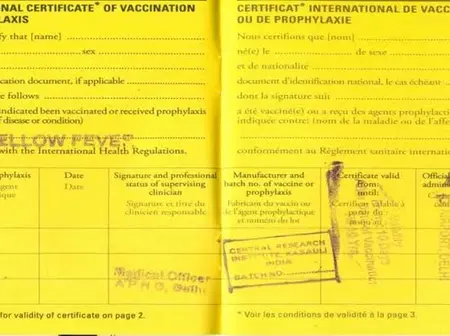
India has proposed a six-day quarantine for travellers arriving from areas considered at risk of yellow fever transmission if they cannot produce valid vaccination certificates, a move that could have implications for Kenyans travelling to the Asian country.
The proposal is contained in India's draft Indian Aircraft (Public Health) Rules, 2026, which seek to tighten disease surveillance and public health controls at international airports.
Under the proposed provisions, travellers arriving from areas where the Indian government has identified a risk of yellow fever transmission would be quarantined until their vaccination certificates become valid or until six days have elapsed from their last possible exposure to the infection, whichever comes first.
The proposed measure is based on the six-day incubation period of yellow fever, the time between infection and the appearance of the first symptoms.
The draft, prepared by India's Ministry of Health and Family Welfare, is part of efforts to replace the existing Aircraft (Public Health) Rules of 1954 and strengthen safeguards against infectious diseases entering the country through international air travel.
Kenya is among the 29 African countries specifically listed by India as having a risk of yellow fever transmission, placing Kenyan travellers within the scope of the proposed health requirements.
The list, contained in Annexure VI of the draft regulations, also includes Uganda, Ethiopia, Nigeria, Ghana, Burundi and other African countries, as well as 13 other countries in Central and South America.
The inclusion of Kenya means travellers departing from the country could be required to demonstrate that they have received the yellow fever vaccine before being allowed to enter India without quarantine.
The draft makes vaccination against yellow fever a condition of entry for travellers leaving areas where the World Health Organisation has identified a risk of transmission.
It states: "Vaccination against yellow fever shall be required of any traveller leaving an area where WHO has determined that a risk of yellow fever transmission is present."
However, travellers with valid vaccination certificates would be exempted from being treated as suspected cases, even when arriving from countries considered at risk.
"A traveller in possession of a valid certificate of vaccination against yellow fever shall not be treated as suspect, even if coming from an area where World Health Organisation has determined that a risk of yellow fever transmission is present," the draft states.
The regulations further provide that yellow fever vaccines approved by WHO offer protection against infection beginning 10 days after administration.
The certificate would remain valid throughout the vaccinated person's lifetime, beginning on the 10th day after receiving the jab.
This means Kenyans planning to travel to India would need to ensure they receive the vaccine at least 10 days before departure and carry the appropriate international vaccination certificate.
Those who have received the vaccine but whose certificates have not yet become valid could still be allowed to depart, although they may face quarantine upon arrival in India.
The draft states that a traveller with a certificate that is not yet valid "may be permitted to depart", but could be subjected to quarantine measures upon arrival.
For those without valid certificates, the proposed rules provide that they "shall be quarantined until the certificate becomes valid, or until a period of not more than six days, reckoned from the date of last possible exposure to infection, has elapsed, whichever occurs first."
The six-day period is tied to the incubation period of yellow fever, which can make it difficult to identify infected travellers immediately after exposure.
Yellow fever is a viral disease transmitted through the bite of infected mosquitoes. Symptoms may include fever, headache, muscle pain, nausea and vomiting, while severe cases can lead to jaundice, internal bleeding, organ failure and death.
The disease remains a public health concern in parts of Africa and South America, with vaccination considered the most effective preventive measure.
For Kenya, the proposed restrictions underscore the importance of vaccination and proper travel documentation, particularly for people travelling to countries with strict international health requirements.
India's draft rules go beyond yellow fever, setting out a broader framework for managing public health threats associated with international aviation.
They provide for medical examinations, laboratory investigations, isolation and quarantine where airport health officials establish reasonable grounds to believe a traveller poses a public health risk.
The proposed regulations also give airport health officers powers to request health documents and other information from passengers to establish their exposure history and assess possible threats to other travellers.
The wider framework seeks to strengthen disease surveillance, aircraft sanitation, vector control and reporting of suspected infectious diseases at airports.
India's Ministry of Health and Family Welfare issued an office memorandum on November 16, 2026, inviting comments and suggestions on the proposed rules.
The ministry said the existing 1954 regulations needed updating following the enactment of the Bharatiya Vayuyan Adhiniyam, 2024, which replaced the Aircraft Act, 1934.
The ministry has invited stakeholders, including government agencies and aviation industry players, to submit their views within 30 days.
After considering the submissions, the draft will be forwarded to the Ministry of Civil Aviation for further action, including publication in the Official Gazette where required.
The proposed six-day quarantine provision is therefore not yet an operative travel requirement. It will be subject to the required approval and formal adoption process before taking effect.
Leave a Reply