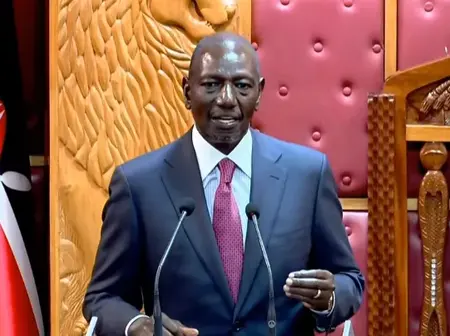
President William Ruto has defended his administration's education reforms, saying increased government investment has eased the financial burden on parents while improving access to learning.
In his fourth State of the Nation Address to a joint sitting of Parliament on Wednesday, Ruto said the education budget had increased from Sh521 billion in 2022 to Sh784.5 billion in the 2026/27 financial year.
He attributed the increased funding to improvements in the sector, particularly the recruitment of teachers, construction of classrooms and expansion of learning facilities.
The President said the government had recruited 100,000 teachers in four years, reducing the need for parents to contribute towards hiring additional tutors through school boards of management.
He announced plans to recruit a further 20,000 teachers in December to address staffing gaps in schools.
"When we assumed office, Kenya faced a teacher shortage estimated at 116,000. Parents in many schools were paying for teachers employed through boards of management while also meeting additional demands of classrooms and learning facilities," he said.
Ruto said increased government investment had progressively reduced the need for Kenyans to finance teaching services and improved the overall quality of education.
He added that the government had constructed 23,000 classrooms and was building and equipping 1,600 laboratories across the country to expand access to learning and reduce pressure on communities to finance school infrastructure.
"Our investment in education has lifted a heavy burden off our parents and helped reduce financial obligations they have been undertaking. This goes a long way in dealing with the challenge of cost of living," he said.
On national examinations, the President said reforms had changed the administration of tests while strengthening safeguards to protect their integrity.
He cited the introduction of examination containers and the withdrawal of police officers from examination rooms while candidates are sitting their papers as some of the measures introduced by his administration.
"The examinations have been conducted in a calm and orderly manner, free from anxiety, tension and intimidating security deployments of the past. This is how it should be. Examinations are a normal part of learning, not a security operation or a matter of life and death," he said.
Ruto said this year's examination cycle, which concludes on Friday, had set a new record, with 3.6 million learners sitting the Kenya Primary School Education Assessment (KPSEA), Kenya Junior School Education Assessment (KJSEA) and Kenya Certificate of Secondary Education (KCSE) examinations.
"For the first time in 65 years, examination papers were printed here in Kenya," he added.
Ruto said the decision followed his reasoning that a country capable of printing its own currency should also have the capacity to produce its examination papers.
"And in this single undertaking, we have taken off close to a billion and a half shillings that could have been wasted," he said.
The State of the Nation Address is a constitutional requirement under Article 132 of the Constitution, which obligates the President to address a special sitting of Parliament once every year.
During the address, the President is required to report on measures taken and progress achieved in realising national values and principles of governance under Article 10. The report must subsequently be published in the Kenya Gazette.
Leave a Reply