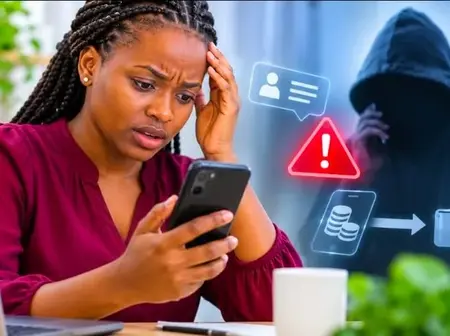
There was a time when fraudsters had a straightforward approach. You would receive a call from someone claiming to be from Safaricom, followed by a request for your PIN. That immediately raised an alarm.
For a while, one message became familiar to mobile money customers: never share your PIN. The warning worked. Customers became more cautious, making it increasingly difficult for fraudsters to steal money by simply asking for someone's PIN.
But fraudsters adapted.
Today, someone calling you may never ask for your PIN. Instead, they may offer to increase your Fuliza limit, improve your business loan limit, resolve an issue with your line or help you access a service.
They may claim that your child is ill and urgently needs medical attention. They may know your name, business details or even a job you recently applied for. In some cases, they may ask you to hand over your phone so they can help you.
The outcome can be the same. Money leaves your account, but this time you may have authorised the transaction yourself.
This is how fraud has evolved. Criminals are increasingly targeting people rather than attempting to break through technical security systems. This approach, known as social engineering, has become a major method of defrauding mobile money customers.
In my work in Safaricom's fraud detection and operations function, I have seen how fraudsters exploit their understanding of products and services to build convincing stories. They understand the products, the customer experience and the situations that can make people vulnerable.
Around 80 per cent of the fraud cases our team sees involve social engineering. This shows how central human behaviour has become to the fraud problem.
The psychology behind social engineering
Most social engineering scams rely on three things: urgency, an attractive offer or an emergency.
For a small business owner, an unexpected offer to increase a loan limit can be difficult to ignore. A fraudster may refer to the customer's transaction history and claim they qualify for a higher limit. The conversation sounds credible because the caller appears to know the customer.
The fraudster may then offer to demonstrate how the process works.
This is where the risk increases. The customer may be persuaded to hand over their phone or follow instructions on the device, believing they are activating a new service. Instead, they may authorise a transaction or give the fraudster access to their mobile money wallet.
Emergency scams use similar psychological tactics.
A caller may claim that a child has been involved in an accident or has fallen ill and needs money immediately. The objective is to create panic and prevent the recipient from verifying the information.
When someone receives such a call, the natural instinct is to help first and ask questions later. Fraudsters exploit this reaction.
Personal information makes impersonation more convincing
Another factor making modern fraud more difficult to identify is the information fraudsters may have about their targets.
Impersonation has become more sophisticated. Fraudsters pose as representatives of trusted organisations and use customers' personal information to make their approaches appear legitimate.
They may claim to represent Safaricom, Kenya Power, Airtel, water companies or other service providers. Some even use branded vehicles, identification tags and other visual cues to appear genuine.
Consider someone who has recently applied for a service and receives a call referring specifically to that application. The caller then asks for money to speed up the process.
This is more convincing than an unsolicited call from a stranger because the caller appears to know something about the customer.
However, knowing someone's name or personal details does not prove that the person contacting them is genuine. Customers must understand this distinction, particularly as more personal information is shared across the digital and physical spaces where people interact.
The smartphone has raised the stakes
The mobile phone has evolved from a communication device into a digital wallet, bank branch, workplace and personal information hub.
A smartphone can contain mobile money services, banking applications, email accounts, social media profiles and business tools. Gaining access to someone's device can therefore expose much more than it did when phones were mainly used for calls and text messages.
Fraudsters may attempt to install malicious applications, access accounts, monitor activity or take over platforms such as WhatsApp and email.
Some attacks begin with suspicious links. Others start with something that appears harmless, such as allowing another person to use your phone.
A customer may believe they are receiving assistance without realising what is happening on the device while it is out of their hands.
As more financial and commercial services move online, protecting a smartphone has become part of protecting personal finances and information.
Artificial intelligence is changing the fraud landscape
Artificial intelligence is adding another dimension to the evolution of fraud.
Fraudsters are increasingly using technology, including AI tools, to identify potential weaknesses, probe applications and develop new ways to target customers.
They also follow changes to products and services closely. When a new feature is introduced, they can quickly develop a convincing story around it and use it as the basis for a scam.
This creates an ongoing race between those seeking to exploit digital systems and those working to secure them.
Technology is also becoming an important part of the defence.
At Safaricom, we are using AI models to analyse transaction behaviour, including customer histories and spending patterns, to identify potentially fraudulent activity.
The objective is to detect suspicious transactions earlier rather than responding only after money has been lost.
We are also developing a validation process that will allow merchants and businesses to establish whether someone claiming to be a Safaricom employee or business associate is genuine.
The process will verify a number against company records before a customer proceeds with an account-related interaction.
Such measures are important because impersonation can be difficult to detect, particularly when fraudsters have invested time in making an interaction appear authentic.
The simplest defence may still be the most effective
Despite the growing role of technology in fraud, one of the most effective ways to protect yourself remains simple: pause and verify.
If someone contacts you and creates a sense of urgency about your account or phone, do not act immediately.
If someone offers an unusually attractive loan or promises to increase your limit, verify the offer independently.
If someone calls claiming there is an emergency involving a family member, contact the school, a relative or the relevant institution directly using a trusted number.
If someone asks for your phone or SIM card to help you, do not hand it over.
The bigger lesson is that protecting yourself against fraud is no longer simply about keeping your PIN secret. It is also about recognising manipulation.
The language has changed because the fraudster has changed. As technology becomes more central to how Kenyans manage money, communicate and access services, staying safe requires more than technical protection.
It requires customers to stop, question and verify before taking action.
For Safaricom customers with concerns about their mobile money wallets or phone lines, the safest approach is to visit an official shop or contact verified customer care channels rather than relying on unsolicited callers or visitors.
Customers can also report suspected fraud through My OneApp or by sending an SMS to 333.
Reporting suspected fraud early gives the relevant teams an opportunity to investigate and, where possible, intervene before funds are moved beyond recovery.
Maurice Orenjo works at Safaricom’s fraud detection and operations unit
Leave a Reply