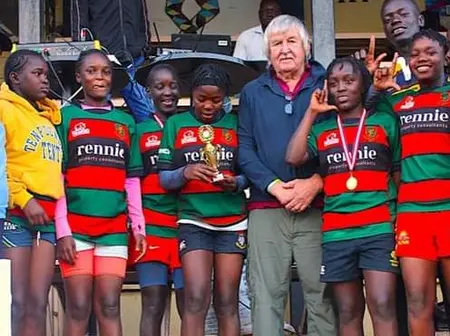
Iestyn Thomas, founder and chief executive of ChallengeAid, is working with children from Mathare, Kibera and other informal settlements through the organisation’s Schools of Hope programme.
His initiative combines education, sports and mentorship, giving young people opportunities to discover their abilities while gaining access to organised sporting competitions.
Thomas has an extensive background in British rugby, having played and coached at Harlequins and London Welsh. He also spent 18 years as head of rugby at Llandovery College in Wales, where he helped nurture young players who would later progress to professional and international rugby.
Among the players he coached was George North, who went on to become one of Wales’ most recognised international rugby players.
Thomas coached North at school in 2008, and their relationship continued beyond the classroom. North later supported ChallengeAid and helped raise funds for its Schools of Hope programme in East Africa.
Another notable player associated with Thomas’ coaching career is England international scrum-half Harry Randall.
Thomas reportedly recognised Randall’s potential despite concerns about his relatively small physical stature. He devised a speed test to demonstrate the youngster’s abilities and encouraged him to pursue rugby despite doubts about whether he could compete against bigger players.
Randall eventually progressed to England’s national team, demonstrating the importance of identifying talent beyond physical appearance.
Thomas is now applying similar principles in Kenya, where he believes children from disadvantaged communities deserve opportunities to develop their sporting abilities.
On Tuesday, November 17, 2026, young rugby players from Nairobi's informal settlements gathered at the RFUEA Grounds for a tournament organised through the Schools of Hope programme.
The event brought together children who have been receiving sporting opportunities through ChallengeAid, with the initiative seeking to expose them to competitive rugby and professional coaching.
According to the organisation, 2,061 children are currently participating in 172 sports teams across seven disciplines.
These include rugby, football, cricket, volleyball, netball, athletics and chess.
The programme also places particular emphasis on increasing girls' participation in sports, ensuring that opportunities are not restricted to boys.
Kenya Rugby Union Age Grade and Development Manager Ronald Okoth praised ChallengeAid for investing in grassroots rugby and encouraged other organisations to support similar initiatives.
He noted that programmes targeting young people could help Kenya identify and nurture future international sporting talent.
Okoth also referenced the success of the Rising Lionesses, who won gold at the 2026 Dakar Youth Olympic Games in Senegal, as an example of what investment in young sporting talent can achieve.
"What ChallengeAid is doing is commendable. As Kenya Rugby Union, we really encourage such programmes, especially now that schools have closed. We also urge other organisations to take this as a challenge," Okoth said.
Thomas expressed satisfaction with the talent he had encountered among children from Nairobi's informal settlements.
He explained that exposing young people to organised sports could help them appreciate opportunities beyond the neighbourhoods where they grew up.
"It widens people's horizons, and young people can see that there is a life outside the informal settlements. Knowing that there was talent in the informal settlements, I now know that there is even greater talent than I first thought," he said.
Thomas added that the abilities demonstrated by some of the Kenyan youngsters compared favourably with those of children he had encountered in the United Kingdom.
ChallengeAid's approach goes beyond organising tournaments. The organisation has also invested in training coaches in rugby, football, cricket, volleyball and netball, while working with sporting institutions, including the Kenya Rugby Union.
Ahead of the Schools of Hope All-Star Rugby Tournament, 69 boys and girls from the Mathare Cluster participated in a training session at Valley Bridge School of Hope.
The youngsters were preparing to represent their respective centres, with coaching sessions focusing on technical skills, teamwork and match preparation.
The planned activities at Kenya Harlequins are also expected to give the children opportunities to train and compete in an environment connected to Kenya's established rugby structures.
Rugby is not the first sport through which Schools of Hope has demonstrated the potential of children from informal settlements.
The organisation has already recorded encouraging results in chess, with several young players progressing to national competitions.
In April 2026, nine Schools of Hope players participated in the Kenyan National Chess Championships, with every participant recording at least 5.5 points from eight games.
Three players scored six points, two managed 6.5 points, while four finished with 5.5 points.
Dennis, who represented the programme in the Under-12 category, emerged as one of the standout performers after collecting seven points from eight games.
His performance earned him a place in the playoffs at Mang'u High School, where he played 11 matches, won five and finished 21st among 33 competitors.
Although he did not finish among the three players who secured international sponsorship, his performance demonstrated the competitive potential emerging from the programme.
The achievement followed another encouraging development in March 2025, when four ChallengeAid players from Mathare and Kibera, comprising two boys and two girls, qualified for the national chess championships after progressing through regional competitions.
The organisation has supported the growth of chess by providing playing equipment, training opportunities and access to volunteer teachers and mentors.
Its wider education programme was established to support children living in informal settlements who face difficulties accessing conventional learning opportunities.
Besides classroom education, Schools of Hope provides extracurricular activities such as music, drama, debating and sports.
The initiative has expanded considerably over the years. In September 2023, its inter-School of Hope tournament attracted approximately 581 boys and girls who competed in cricket, football, rugby, netball and volleyball.
ChallengeAid also reported that the number of girls participating in its sports teams increased from 280 in 2022 to 844 in 2023.
The organisation was founded in 2005 by Thomas and a group of former rugby-playing friends and colleagues.
Initially, the group organised sporting challenges and fundraising activities in the United Kingdom to generate resources for educational projects in East Africa.
Over time, the initiative developed into a wider programme combining education, mentorship and sporting opportunities for children in Kenya and Tanzania.
Thomas has also relied on his connections within the British rugby community to attract support for the organisation.
Harry Randall, who previously played under him, has also served as a ChallengeAid ambassador, helping strengthen the connection between British rugby and the charity's work in Kenya.
For the youngsters from Mathare and Kibera, this relationship offers an opportunity to interact with coaches and sporting networks that might otherwise remain beyond their reach.
The immediate focus is on developing the Schools of Hope rugby programme and preparing children for competitive tournaments.
However, the broader ambition is to establish a sustainable pathway through which talented youngsters can progress from community training sessions to higher levels of competition.
His work in Kenya is not simply about finding the next George North or Harry Randall. It is about ensuring that a child's background or neighbourhood does not determine how far their sporting ambitions can go.
Source
Leave a Reply