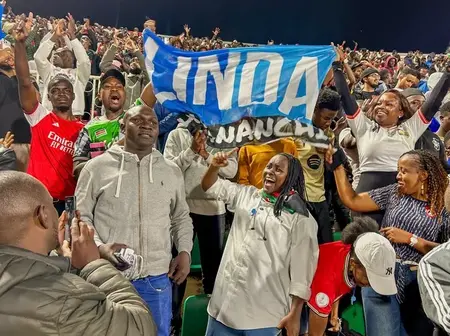
Kenya's 2-1 defeat to South Africa at Nyayo National Stadium was not the only major talking point during Tuesday night's 2027 Africa Cup of Nations (AFCON) qualifier. The match also drew political attention after supporters linked to the Linda Mwananchi Movement displayed a banner backing Nairobi Senator Edwin Sifuna.
The incident, involving a group of young supporters mobilised by Linda Mwananchi youth leader Fredah Onduso, has sparked debate among Kenyans over the growing intersection between politics and football.
Although the group attended the match to support Harambee Stars, the appearance of a politically branded banner inside the stadium raised questions about whether national sporting events should be used to promote political movements.
The incident has also renewed discussions about FIFA regulations regarding political demonstrations during football matches, with some Kenyans expressing concern that such actions could expose the country to disciplinary measures.
Fredah Onduso, a prominent figure within the Linda Mwananchi Movement led by Edwin Sifuna, mobilised a group of young supporters to attend Kenya's clash against South Africa.
The supporters were seen cheering on Harambee Stars while displaying a banner associated with the movement.
In a statement shared on social media, Onduso said she had led the youth league in supporting the national team while calling on the government to invest more heavily in sports and create economic opportunities for talented young people.
"Today I led the youth league in cheering for and applauding our very own Harambee Stars in their game against South Africa. Our government must be deliberate about supporting talent and move Kenya from a sports culture to a sports economy. Jibu Ni Sifuna," she stated.
However, not everyone welcomed the move.
Some football fans questioned why political branding was introduced into a national team match, arguing that football should remain a space where Kenyans unite regardless of their political beliefs.
The controversy has turned attention to FIFA's regulations on political demonstrations during football events.
Under Article 13(2)(c) of the FIFA Disciplinary Code, the use of football matches for demonstrations of a non-sporting nature is prohibited.
The rule is intended to ensure that football competitions do not become platforms for political, religious, or other non-sporting activities.
FIFA's stadium regulations also restrict political materials, including banners, flags, clothing, and other items carrying political messages.
As a result, political demonstrations inside stadiums can attract scrutiny from football authorities, depending on the circumstances of each case.
Despite the public debate surrounding the Linda Mwananchi banner, there has been no official confirmation that FIFA has opened disciplinary proceedings against Kenya over the incident at Nyayo Stadium.
The situation has reminded many football observers of a disciplinary case involving Argentina during the 2026 FIFA World Cup.
Following Argentina's semifinal victory over England, players displayed a banner reading, "Las Malvinas son Argentinas," a reference to the long-running territorial dispute between Argentina and the United Kingdom over the Falkland Islands.
The incident drew international attention and later formed part of FIFA's disciplinary investigations involving the Argentine Football Association.
On July 29, 2026, FIFA confirmed that its Disciplinary Committee had opened proceedings over several incidents, including the display of inappropriate messages by players and supporters.
FIFA later imposed sanctions on the Argentine Football Association, including a fine of $321,000 and spectator restrictions for two home matches. Among the cited breaches was Article 13(2)(c) of the FIFA Disciplinary Code.
While Argentina's case involved multiple incidents, it demonstrated FIFA's willingness to take action against political or non-sporting demonstrations during football matches.
The incident at Nyayo Stadium has generated mixed reactions among football fans.
Some supporters questioned the decision to introduce political messaging into a national team fixture.
One Kenyan identified as Kirwe argued that political groups should organise their own events rather than use football matches to gain visibility.
"Stop using football fans to advance your political agenda. If you believe you have genuine public support, organise your own rally under Linda Mwananchi and let the numbers speak for themselves. Don't hide behind football crowds," Kirwe stated.
Another supporter, Owen, warned that bringing politics into football could expose Kenya to unnecessary issues with FIFA.
Charles also argued that football should offer Kenyans a chance to enjoy the game without being drawn into political disagreements.
However, not everyone opposed Onduso's actions. Some supporters praised her efforts to mobilise young people and welcomed her call for increased government investment in sports and youth talent development.
The differing reactions show how the incident has evolved into a broader political discussion that extends far beyond football.
The key question remains whether the display of the Linda Mwananchi banner could lead to disciplinary action against Kenya.
While FIFA regulations provide grounds for investigating certain political demonstrations during football matches, the mere presence of a political banner does not automatically result in sanctions.
Football authorities would likely consider several factors, including the nature of the message, the circumstances under which it was displayed, the competition's regulations, and the responsibility of the individuals involved.
The controversy comes at a crucial time for Kenyan football, with the country preparing to co-host the 2027 AFCON tournament alongside Uganda and Tanzania.
As the tournament approaches, Kenya will be keen to maintain strong football structures, effective organisation, and a positive international image.
For many supporters, the issue comes down to one simple principle: football should remain a unifying force rather than another arena for political rivalry.
While Kenyans have a constitutional right to express their political views, sporting events must also operate within the regulations that govern international football.
Whether the Nyayo Stadium incident attracts further attention from FIFA remains uncertain. For now, however, the debate has reignited an important discussion about where the line should be drawn between politics and sport in Kenya.
Leave a Reply