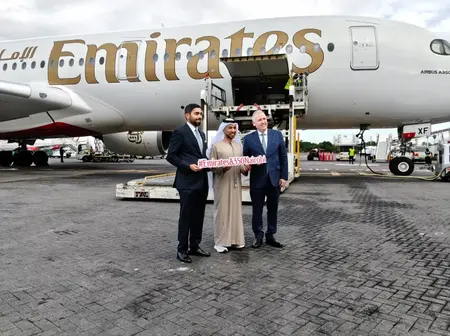
Emirates is deploying newer, fuel-efficient aircraft on its Nairobi route as the airline seeks to contain rising operating costs while responding to growing passenger demand between Kenya and its global network.
The Dubai-based carrier has introduced the Airbus A350 on the Nairobi-Dubai route, adding a new aircraft type to its Kenyan operations as it expands capacity and upgrades its passenger offering.
The move comes amid mounting pressure on airlines from rising global fuel prices, with carriers increasingly looking to modernise their fleets and improve fuel consumption to protect margins.
Rashid Al Arda, Emirates Vice President for Commercial Operations in Sub-Saharan Africa, said the A350 offers better fuel efficiency and lower unit costs compared with the larger Boeing 777, despite carrying fewer passengers.
“The A350, in terms of capacity, offers fewer seats than the 777, but we think it offers greater efficiency in terms of consumption and unit cost,” said Al Arda.
He said the aircraft's introduction was part of the airline's broader strategy to expand its operations in Kenya while improving efficiency and passenger experience.
Emirates has also increased its Nairobi operations to three daily flights, with the additional frequency aimed at meeting rising demand from passengers travelling to and from Kenya.
Kenya is among the airline's five largest markets in Sub-Saharan Africa and its second-biggest market in the region by capacity after South Africa.
The additional flight also strengthens connections through Dubai for travellers from Europe and the United States, making Nairobi an important part of the airline's international network.
Despite introducing the newer aircraft, Emirates says it does not intend to adjust ticket prices on the Nairobi route because of the change in aircraft.
Al Arda said the airline was instead relying on measures such as fuel hedging and other cost-management strategies to cushion itself against volatility in global fuel prices.
“The aviation industry as a whole is under a lot of pressure due to fuel prices globally. Emirates is no exception. We continue to try and mitigate these costs with strategies such as hedging fuel,” he said.
The aircraft deployment also forms part of Emirates' wider fleet modernisation programme, which includes a $5 billion investment to upgrade more than 200 Boeing 777 and Airbus A380 aircraft.
The refurbishment programme has already passed the 100-aircraft mark, with the airline targeting approximately 115 upgraded aircraft by the end of this year.
However, the programme has faced delays linked to global supply chain constraints, while delayed deliveries of Boeing's 777X aircraft have also affected the airline's fleet expansion plans.
Emirates is continuing to receive new A350 aircraft monthly, which it is deploying on routes capable of accommodating the aircraft.
On the Nairobi route, the airline will continue operating two Boeing 777 aircraft alongside the A350. The 777s will retain first-class cabins, while the refurbishment programme is expected to introduce refreshed interiors and premium economy seating.
The A350 brings Emirates' latest premium economy product to Kenya, alongside updated business and economy class cabins.
The airline expects the combination of newer aircraft, improved fuel efficiency and upgraded cabins to strengthen its competitiveness in the Kenyan market.
Al Arda said Emirates would continue evaluating opportunities to expand its African operations, although its immediate priority was to make the additional Nairobi frequency commercially successful.
The airline is also expanding A350 operations across African markets, including Ethiopia, Uganda and Cape Town, as it gradually introduces newer aircraft across its network.
Leave a Reply