In May 2018, members of the Dutch parliament questioned their aid minister over an apparent contradiction. Rwanda, a major recipient of Dutch development assistance, had just signed an estimated $40 million deal to place Visit Rwanda on the sleeves of every Arsenal jersey. This deal was nearly equivalent to an entire year’s worth of direct bilateral aid from the Netherlands.
The legislators asked how a country that receives so much aid could justify such an expense. That year, Rwanda received $1.2 billion in total net official development assistance from all development partners combined. Rwanda’s tourism chief replied that marketing is a fundamental cost of doing business, arguing that critics who balked at the deal on the grounds that Rwanda is poor, either wanted the country to stay poor or fundamentally misunderstood how economic growth works.
Today, the ledger is fully open. Rwanda’s tourism revenue was roughly $404 million when the Arsenal deal was announced in 2018, then rose to $647 million in 2024, and reached $685 million last year. No honest economist would have credited a shirt sleeve with a rise of nearly 70 per cent. The aviation, hospitality and MICE infrastructure all did the heavy lifting.
Far from treating the deal as a vanity project, Kigali banked the returns and pivoted in July to an even larger principal partner deal with Aston Villa, proving that strategic destination branding is not what waste looks like. This extended its visibility beyond tourism to investment, trade and professional development.
Now the question has travelled from the Dutch parliament to Nairobi.
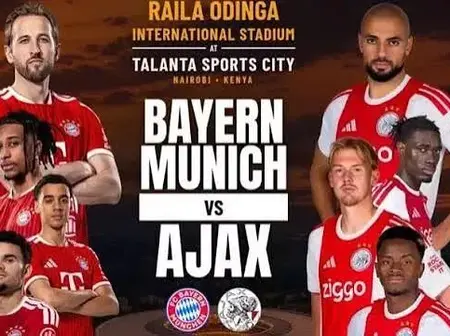
On January 5 next year, Bayern Munich and Ajax are scheduled to inaugurate the Raila Odinga International Stadium at Talanta Sports City. President William Ruto presented the fixture as a milestone in Kenya’s preparations to co-host Afcon.
The announcement has generated both excitement and litigation. Six petitioners have moved to the High Court seeking to block the use of public funds for the fixture and compel disclosure of the underlying contracts, even as the Sports Principal Secretary Elijah Mwangi maintains that a private corporate model is funding the event, although private sponsors or corporate entities have not been named.
Meanwhile, the Kenyan public delivered its own verdict at the box office. Tickets in the Sh2,500, Sh3,500 and Sh5,000 tiers sold out a few hours after sales opened.
Whatever one’s position on the event, there is evidently a substantial market for watching elite European football live in Nairobi. The argument, therefore, is not whether football has an audience. It is whether Kenya can convert that audience into an industry.
Yet the sharper form of the question from the critics has little to do with Nairobi at all. It is aimed at the stadia rising across counties from Wajir to Vihiga, where critics of shiny things ask why the state is pouring money into arenas where football is presumed not be a sport.
Wajir provides a particularly revealing answer in the Ahmed Khalif Wajir Stadium.
Ahead of the this year’s Madaraka Day celebrations on June 1, the government handed over the 10,000-seat facility complete with a standard football pitch and an eight-lane athletics track, the first in Northeastern built to international standards. For a region long disadvantaged in access to quality sporting infrastructure, the investment represented more than a new venue for national ceremonies.
A local player told reporters that before it existed, teams had to sprinkle water onto bare dust just to keep it down before kick-off. Yet on that very dust, Wajir’s youth side reached the 2024 Kenya Youth Inter-County Sports Association football final after toppling defending champions Homa Bay. The Wajir All Stars, meanwhile, clinched the Safaricom Chapa Dimba Northeastern regional title, part of a streak in which local teams repeatedly advance to inter-county finals.
A desk survey conducted in a Nairobi office would have recorded that football is not a Wajir sport. The tournament records tell a different story. The talent existed before the infrastructure. What was missing was a dependable system for developing and displaying it.
By Madaraka Day, shopkeepers, hoteliers, boda boda riders and food vendors were already trading briskly on the crowds. One resident described the ground as a rare space where people from different clans and backgrounds converge. Those are dividends that no gate receipt will ever record.
The skeptics do not surprise economists. You see, demand is not a quantity waiting on a table. It is revealed by action, and action needs an option. Nobody knows how many boys and girls in Wajir will play on a makeshift pitch until there is a good pitch, and a survey measures what people do in the absence of the thing, which is a poor guide to what they will do in its presence.
A proper pitch enables organised fixtures which in turn attract coaches, spectators and scouts. Regular competition creates opportunities for vendors, transport operators and accommodation providers. An athletics track alongside the pitch offers a second route for talent discovery if running proves more promising than football. Ultimately, the stadium creates possibilities that did not previously exist.
In economic-speak, this is called the problem of dispersed knowledge. In 1945, the Austrian economist Friedrich Hayek argued that economically useful information is dispersed among individuals and embedded in particular circumstances of time and place. No senator or social media critic possesses all the knowledge necessary to determine every productive opportunity. They cannot possibly know which 14-year-old in Wajir has a left foot worth a career, for the plain reason that the fact does not yet exist in any file. It exists on a dusty ground, in the legs of a child and surfaces only when someone who knows what to look for is standing at the touchline.
A stadium does not find talent. But it is the place where someone can be standing when talent shows up. A pathway turns that into a system from the ground, the local coach, the registered fixture and the data that travels upward. In this sense, infrastructure does more than facilitate activity. It creates the conditions under which such knowledge becomes discoverable.
Hosting the Bayern vs Ajax friendly match presents Kenya with a different opportunity. It is where sports and creative diplomacy earn their keep in expanding our international economic relationships. Sports diplomacy builds relationships through the extraordinary emotional reach of competition. Creative diplomacy uses music, performance, design, film, fashion and cultural expression to make a country visible and memorable.
Neither Bayern nor Ajax is a government nor an official diplomatic mission. Yet each possesses international visibility and emotional influence that conventional diplomacy would struggle to replicate. Their presence in Nairobi opens possibilities for relationships extending into coaching education, sports science, technology, institutional management, tourism and commercial investment. This is the practical value of sports diplomacy.
Begs the question. What is Kenya buying beyond the 90 minutes?
Lets imagine the possibilities.
Kenyan musicians and performers could introduce global audiences to the country’s creative industries. Local designers, hotels, transport companies and restaurants could integrate the match into an identifiable sports-tourism offering.
More importantly, Kenya could use the occasion to establish relationships involving coaching exchanges, academy development, sports medicine, performance analytics and stadium management.
I submit that the real ambition of this initiative will not be measured by the calibre of these two teams. It will be by the place Kenya eventually occupies in the international football economy.
For too long, Kenya has been an enthusiastic consumer of European football. Every weekend, millions of Kenyans follow European clubs, purchase merchandise, subscribe to broadcasting services and generate enormous digital engagement. Local conversations, rivalries and even social identities are increasingly organised around clubs thousands of kilometres away.
This enthusiasm has commercial value, but much of that value is captured elsewhere. European clubs monetise African loyalty through broadcasting rights, sponsorships, merchandise and expanding international audiences. African supporters contribute to this economy without necessarily participating in the institutions that control its production.
Hosting Bayern Munich and Ajax thus offers an opportunity to begin altering that relationship. For once, the football product comes to Kenya. So this encounter should be treated as the beginning of an institutional business model rather than the culmination of a construction project.
Six months after the Bayern-Ajax match, Kenya, Uganda and Tanzania are scheduled to co-host Afcon. Transport systems, ticketing infrastructure, security arrangements, hospitality services, immigration facilitation, broadcasting facilities and crowd management will all influence the experience of visiting teams, spectators and international organisers.
The January fixture therefore offers an unusually valuable opportunity to test several of these systems under real conditions. Every operational weakness identified in January will become an opportunity for improvement before June. This matters because international reputation is not built by the announcement of a major event. It is built through consistent delivery. And the confidence of international sporting organisations and investors depends on practical evidence that a destination can organise complex events efficiently and professionally.
In this sense, Bayern and Ajax are not merely inaugural guests. They will function as a substantial operational rehearsal for Kenya’s wider sporting ambitions.
Finally, my unsolicited advice is to Ruto’s government. Do not allow Bayern and Ajax to leave Kenya having delivered only a football match. Negotiate a legacy package before the teams arrive. Secure coaching clinics, talent-identification engagements, technical exchanges and commercially viable collaborations with Kenyan institutions and individuals. Give local creative enterprises meaningful participation in the event rather than decorative appearances at the opening ceremony. Then connect the international exposure so that a gifted teenager in Wajir or Turkana has a better route into professional sport.
The Dutch legislators were right to demand an answer from their aid minister. Rwanda was equally entitled to invest in its economic future. The two positions were never mutually exclusive. The more useful question was whether the sponsorship formed part of a credible strategy capable of generating returns beyond its immediate publicity. And the mistake would be to confuse the cost of creating an opportunity with proof that the opportunity has no value. An equally serious mistake would be to assume that creating the opportunity guarantees its value.
The final score will be decided in 90 minutes. The economic result will be felt beyond those 90 minutes.
The difficulty lies, not in the new ideas, but in escaping from the old ones – John Maynard Keynes
Leave a Reply