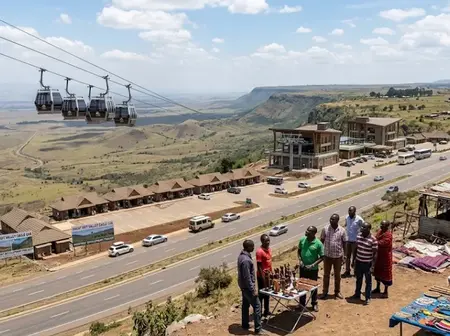
For decades, motorists travelling between Nairobi and Nakuru have stopped at the Great Rift Valley Viewpoint to admire one of Kenya’s most spectacular natural landscapes.
But the familiar roadside attraction could soon offer visitors an entirely different experience, with plans for cable cars, luxury hotels and modern shopping facilities.
The proposed transformation under the Rironi-Mau Summit highway project could see tourists suspended above the escarpment in passenger cabins, enjoying aerial views of the vast Rift Valley while moving between two sections of the highway corridor.
Roads and Transport Cabinet Secretary Davis Chirchir revealed the ambitious vision during an inspection tour of the ongoing highway construction, describing the proposed development as a world-class tourism attraction.
“It will be world-class, with cable cars connecting the A8, the corridor which we are in now, to the A8 South, the escarpment corridor. It will be a magnificent tourism site,” Chirchir said.
The proposal could fundamentally change the identity of the Great Rift Valley Viewpoint, transforming it from a popular roadside photography stop into a more elaborate tourism and hospitality destination.
But as the government looks towards a modernised attraction, another question is emerging: What will happen to the hundreds of small-scale traders whose livelihoods have depended on the famous viewpoint?
The proposed cable car system is arguably the most eye-catching feature of the government’s vision for the Great Rift Valley Viewpoint.
Instead of simply stopping along the Nairobi-Nakuru highway to admire the escarpment, visitors could eventually board suspended passenger cabins and travel across the steep terrain, enjoying aerial views of the surrounding landscape.
According to Chirchir, the cable cars will connect the A8 highway corridor to the A8 South, creating a new tourism experience around the escarpment.
The government also intends to introduce modern curio shops and attract private investors to establish hotels, giving visitors more reasons to spend time and money at the attraction.
“We are going to leverage on the God-given tourist attraction of the Rift Valley, and so we are going to do a lot of work at that viewpoint,” the Cabinet Secretary stated.
If implemented, the proposed facilities could create new opportunities for tourism businesses, hospitality operators and local enterprises while giving domestic and international visitors another reason to explore the Great Rift Valley.
Beyond tourism ambitions, the government says the existing viewpoint requires a major redesign, particularly because of concerns surrounding visitor safety.
Chirchir argued that although the location is already popular with travellers, its current layout does not adequately address safety considerations.
“At the moment, the viewpoint is a good place, but the safety aspect of the design and the way it has been developed is not properly done,” he said.
The proposed redevelopment is therefore expected to reorganise the attraction, introduce more structured commercial spaces and improve how visitors access and experience the site.
Modern curio shops would replace the informal roadside trading arrangement, while potential hotel investments could introduce a hospitality component that is currently missing from the attraction.
“We are going to do curio shops that will encourage tourists to stop and want to spend time. We will probably get investors putting up hotels,” Chirchir added.
However, important details, including the proposed investment costs, cable car construction arrangements, private investor commitments and implementation timelines for the viewpoint redevelopment, are yet to be publicly established.
While the proposed transformation promises a new tourism experience, it also threatens to reshape the livelihoods of people who have depended on the Great Rift Valley Viewpoint for years.
The ongoing Rironi-Mau Summit highway expansion has already resulted in the demolition of traditional curio stalls, disrupting businesses that served motorists and tourists travelling along the busy Nairobi-Nakuru highway.
For years, traders have earned their income selling Maasai shukas, handmade beadwork, soapstone carvings and other souvenirs to visitors stopping to admire the spectacular escarpment.
Reports indicate that close to 300 people, including employees and small-scale vendors, depended on commercial activities around the attraction.
The affected traders have urged authorities to ensure they are incorporated into the redesigned facility, warning that the transformation should not leave behind the very people whose businesses helped make the viewpoint a familiar stopover.
Their concerns raise a critical question about the future of the attraction: Will the new curio shops provide opportunities for existing traders, or will the arrival of high-end hotels and private investors change who can afford to operate there?
The viewpoint redevelopment forms part of the wider Rironi-Mau Summit highway project, launched by President William Ruto in November 2025 under a public-private partnership.
The project covers the A8 highway between Rironi and Mau Summit, alongside the A8 South corridor connecting Rironi to Naivasha through Mai Mahiu. Completion is targeted for June 2027.
As the government pursues its ambitious highway and tourism plans, the Great Rift Valley Viewpoint could be heading towards its biggest transformation yet.
But whether that transformation becomes a success story for both tourism investors and ordinary Kenyan traders remains an important question.
Leave a Reply